Call Us Today!
Call Us Today!

Wood does not rot because it gets wet. It rots because it stays wet. The USDA Forest Products Laboratory is precise about the threshold: decay fungi need moisture above the fiber saturation point, roughly 30 percent moisture content, and serious decay occurs only above that point. The same source treats 20 percent as the lower limit that provides a margin of safety against decay developing. The same source puts the temperature range those fungi work in at 10 to 35 degrees Celsius, with an optimum of 24 to 32.
Read those two conditions together and a failing gutter starts to look like a structural problem rather than a cosmetic one. Of the conditions decay needs, moisture is the one a homeowner can actually control, and a gutter that overflows, leaks at a seam, or sheds water behind itself is what keeps the fascia sitting above the threshold instead of drying between rains. At Big Easy Gutter, that is the failure we are called out to most often, and it is almost always older than the homeowner thinks.
If your fascia is showing any of the signs below, contact us for an assessment before the next repair gets bigger.
The fascia is the board running along the roof edge. It closes the end of the rafters and, on most homes here, it is what the gutter is fixed to. The soffit is the underside panel between that board and the wall.
Both are protected by position rather than by material. They sit tucked under the roof edge, out of the direct weather, which is why they are usually ordinary wood rather than anything specified to be wet. That arrangement works perfectly until a gutter starts putting water where the design assumed there would not be any.
Once that happens, the fascia is in a poor situation: wood that was never meant to be wet, held against a recurring water source, under a roof that shades it from the sun that would otherwise dry it out.
There is a second reason the roofline is the wrong place for this to happen. Fascia and soffit are structural in a modest but real way. The fascia closes and stiffens the rafter ends and carries the gutter’s weight plus whatever water and debris are sitting in it. The soffit closes the eave and, on most homes, carries the ventilation path into the roof space. Softening either one means the roof edge loses stiffness, the gutter loses its fixing, and the vents can end up blocked or displaced. None of that announces itself the way a roof leak does.
It is also the part of the house nobody looks at. Roofs get inspected, walls get painted, and the board between them gets noticed when a gutter falls off it.
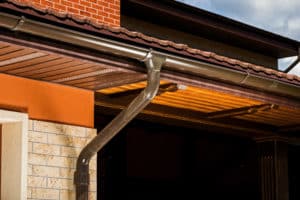
These are visible from the ground or from a ladder, and they arrive in roughly this order.
Paint fails from behind when moisture pushes out through the board. A blistered strip that follows the gutter line, rather than random patches across the elevation, is the classic pattern. It means water has been in the wood long enough to move.
At this stage the board underneath may still be sound. This is the cheapest moment to act and the one most often passed over, because it reads as a painting problem.
The test that settles it takes a minute. Press the board firmly with a screwdriver in several places along the run, especially directly under the gutter and at the ends of each section. Sound wood pushes back. Wood that takes the tip without much resistance has already started to go, and the paint was telling the truth.
Water that gets behind the fascia travels along the underside. Brown staining, panels that have dropped at one edge, or a visible gap where the soffit meets the wall all mean the water has been running there for a while.
Sagging in particular is telling, because a panel does not drop until whatever holds it has softened or the fixings have lost their grip.
Staining is worth reading carefully too. A stain that runs in a line along the soffit suggests water traveling from a specific point, usually a seam or an end cap. A broad, patchy stain across several panels suggests water getting in along the whole run, which usually means the gutter is overflowing rather than leaking.
If a section of gutter has tilted, dropped, or pulled its spikes and hangers loose, check what they were fixed into. A fixing can only hold as well as the material around it, so a gutter that will not stay attached is often reporting the condition of the fascia rather than a hardware problem.
Refastening it into the same rotten board buys a short reprieve rather than a fix, and the returning sag is the giveaway.
Worth checking the whole run rather than the obvious section. The fixing that let go first is simply the one where the wood softened first, and the neighboring board is usually not far behind.
Some of the evidence is not visible at the roofline at all.
Stand outside during heavy rain and watch. Water that runs behind the gutter instead of into it is going directly onto the fascia, every time it rains, for as long as the condition lasts. The usual causes are a gutter set too low for the roof edge, a missing or misfitted drip edge, or debris backing water up over the rear lip.
This is the mechanism that does a great deal of damage for very little visible drama, because from the ground the gutter looks like it is working.
It is worth going out and actually watching during a heavy downpour rather than reasoning about it from a dry day. Water finds paths that are not obvious from an inspection, and five minutes in the rain tells you more about where it is going than an hour on a ladder afterwards.
A gutter that clogs in the same spot after every clean is telling you about pitch. Water sitting in a low section holds debris, and standing water is heavier and stays in contact with the back of the gutter far longer than moving water does.
That weight is worth thinking about. Water and saturated debris sitting in a sagging section add load at the hangers, and the hangers are fixed into the board that has already been getting wet. The two conditions tend to make each other worse.
Wood that has stayed damp long enough to soften is easier for insects to work. Activity concentrated at the roofline, rather than spread around the structure, points at a moisture source directly above it. That is worth treating as a gutter question as well as a pest question.
Treating only the insects leaves the conditions that attracted them, which is why the two trades often end up working on the same house in the same year.
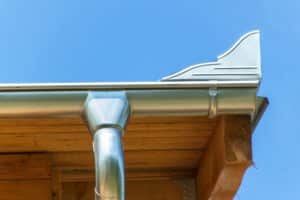
Several conditions here stack against the roof edge at once.
| Factor | Effect on the Roofline | What Helps |
|---|---|---|
| Sustained warmth | The Forest Products Laboratory puts decay fungi’s working range at 10 to 35 degrees C, with an optimum of 24 to 32. Compare that range against your own local conditions through the year | Controlling moisture is the only lever you have, which makes the gutter the control |
| High ambient humidity | Wet wood in a shaded, humid position sheds moisture slowly, so it spends longer above the threshold after each rain | Keep water off the board in the first place, since drying cannot be relied on to finish the job |
| Heavy, concentrated rainfall | A gutter that copes with light rain can overflow in a downpour, and overflow at the rear lip lands straight on the fascia | Check capacity and pitch against the worst rain, not the average, and clear the outlets |
| Heavy tree cover | Leaf and seed debris blocks outlets and holds a wet mass against the gutter’s back edge, right where the fascia is | Clear on a schedule set by the trees over the roof rather than by the calendar |
The same overflow that rots a roofline also runs down the wall and into the ground beside the house, which is a separate problem with the same cause. We covered where that water ends up in our piece on gutter overflow and your foundation.
Here is the part that decides whether a repair lasts. Replacing rotten fascia without fixing what wetted it puts new wood into the same conditions that destroyed the old wood. It will look right for a season or two and then follow the same path.
The order that works is: find where the water is getting onto the board, correct that, then repair or replace what has already gone, then re-fix the gutter into sound material. Skipping the first step is a common reason a homeowner pays for the same roofline twice.
It is worth being specific about what that first step covers, because it is more than clearing leaves. It means checking the pitch along the whole run, confirming the gutter sits at the right height relative to the roof edge, establishing whether there is a drip edge and whether it directs water into the gutter rather than behind it, checking the seams and end caps, and confirming the outlets and downspouts actually clear.
Any one of those left unaddressed will keep putting water on new wood.
Here at Big Easy Gutter, we handle fascia gutters and gutter repair across the New Orleans area, and we look at the water path before quoting the woodwork.
Call us at (504) 208-2247 and we will take a look at your roofline.
How do I know if my fascia is rotten or just needs paint?
Press it firmly with a screwdriver or an awl in several places along the gutter line. Sound wood resists, softened wood gives. Paint failure in a line along the fascia is the early warning, and at that stage the board underneath may still be fine.
Can rotten fascia be repaired instead of replaced?
It depends how far it has gone and over what length. Localized softening caught early is often repairable, while a board that has gone soft along a run usually needs replacing, because the gutter has to fix back into something solid.
How long does it take for a gutter leak to rot the fascia?
There is no fixed answer, because it depends on how much water reaches the board and how often it dries. What the USDA Forest Products Laboratory establishes is the condition rather than the timeline: serious decay needs the wood held above roughly 30 percent moisture content. A leak that keeps the board above that threshold is the situation to worry about, and one that lets it dry between rains is not the same problem.
Why does my gutter keep pulling away from the house?
Often because the wood it is fixed into has softened. A fixing depends on the material holding it, so a gutter that will not stay attached is worth checking at the board before it is checked at the hardware.
Is soffit damage always caused by the gutters?
Not always, since roof leaks and wall problems can put water there too. Gutters are the most common source when the damage follows the gutter line, and tracing where the water actually enters is the first step either way.
Will gutter guards stop fascia rot?
They reduce blockages, which removes one of the causes, but they do not correct a gutter that is pitched wrong, set too low for the roof edge, or missing a drip edge. If water is running behind the gutter, guards will not change that.
Should I fix the fascia or the gutter first?
Fix the water path first, then the wood. New fascia installed under a gutter that still overflows is put back into exactly the conditions that rotted the original.
Does this only affect older homes?
No. Age makes it more likely, because there has been more time for a small fault to run, but the conditions are the same on any house where water is reaching the board and not drying off.

 Big Easy Gutter