Call Us Today!
Call Us Today!

A clogged gutter is not just a drainage problem in this city. It is a container of still, shaded, warm water sitting ten feet above a yard that already fights mosquitoes for half the year, and it is the one breeding site most homeowners never think to check.
Ask most people in the metro where mosquitoes come from and the answers are predictable. The ditch. The neighbor’s pool. The saucer under a potted plant.
All reasonable, and all incomplete.
Almost nobody says the roofline. Yet a blocked trough holds water longer than a flowerpot does, sits out of sight, and never gets tipped out by someone walking past.
The New Orleans Mosquito, Termite and Rodent Control Board keeps its advice to residents short: remove standing water from your yard.
A blocked gutter is standing water. It simply sits above the yard instead of in it, which is the only reason it escapes the usual walk-around.
At Big Easy Gutter, we clear troughs across the New Orleans area, and the ones packed with wet, half-rotted leaf matter are almost always on houses where nobody suspected a thing.
If your gutters have not been cleared this year, contact us and we will take a look at what is sitting up there.
A blocked trough is not a nuisance that turns into a breeding site eventually. It becomes one on a timeline measured in days.
Mosquitoes will use water that has been still for roughly a day. Once eggs are laid, larvae commonly hatch within 24 to 48 hours depending on temperature.
In summer heat the full cycle from egg to flying adult often runs about seven to ten days. A trough that holds water for a week after every rain can run that cycle again and again through a New Orleans summer.
Public-health guidance repeats one point because it keeps being true: a very small volume of still water is enough. Not a pond, not a flooded yard.
A low spot in a blocked gutter holds many times that. So the useful question is not whether your gutters are full. It is whether any section still holds water a week after it rains.
Every other container on a property gets disturbed. Someone tips the flowerpot saucer, moves the wheelbarrow, empties the bucket.
Nothing disturbs a gutter. It is out of sight from the yard, it refills on its own, and it holds water in the shade where evaporation is slowest. That combination is what makes it effective rather than merely possible.
The mosquitoes are the visible consequence. They are not the only one.
Water standing against the back of a trough sits directly against the fascia board, and in this humidity that wood stays wet rather than drying between rains. Soft fascia will not hold a fastener, so the run begins to sag, which deepens the low spot, which holds more water. The problem compounds instead of staying level.
Overflow at the front edge does its own damage further down, running behind siding and landing at the foundation. So a single blocked section is producing a breeding site, rotting the board holding the gutter up, and steering roof water at the base of the house at the same time.
Three local conditions stack up here in a way they do not in most of the country.
Live oaks, crepe myrtles and magnolias do not drop everything in one tidy autumn window. Debris arrives in every season, which means there is no single annual cleanup that covers the year.
Leaf matter that would dry out and blow clear of a trough in a drier climate stays damp here. Wet debris packs down, holds its own water, and turns into a sponge rather than something the next rain flushes away.
The city averages roughly 62 to 66 inches a year, with the heaviest months falling in summer, and it does not arrive as gentle drizzle. Heavy bursts drive debris hard toward the outlet, where it wedges into the opening.
The result behaves less like loose leaves and more like a dam, and it refills faster than most homeowners expect.
A clogged gutter rarely holds water evenly. Knowing the four usual spots saves time.
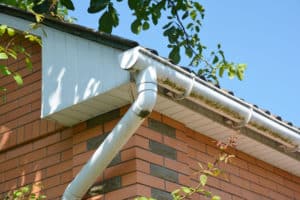 Debris migrates toward the drop and packs at the opening. Water backs up behind the plug, so the deepest standing water usually sits closest to the outlet.
Fasteners loosen, the trough dips between them, and that dip holds water even when the rest of the run drains normally. A sag barely visible from the ground can hold water for days.
Almost nobody checks this one. A blockage at an elbow holds a column of water above it that is enclosed, dark and completely undisturbed.
Guards fail quietly. A mat of fine debris on top sheds water straight over the edge while the trough underneath still holds whatever got in before.
On raised and pier homes the discharge point deserves its own look. Water dropped at the base of a pier runs under the house, where there is shade, no airflow to speak of, and nothing to move it along.
That is the same set of conditions as the gutter itself, only at ground level and harder to see. Clearing the roofline and then releasing everything into the crawl space simply relocates the problem eight feet down.
The fix is not a spray and it is not a gadget. It is making the water leave and keeping it leaving.
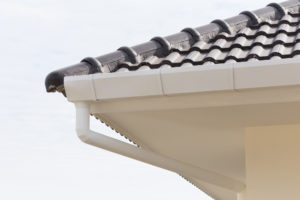 Clear end to end, not just the visible sections, then flush the downspout and confirm flow at the bottom. If water goes in at the top and nothing comes out below, the trough is clean and the problem is not solved.
A section that still holds water after a full clearing is a pitch problem, not a debris problem. It will keep holding water no matter how often it is cleaned, and that is a gutter repair job rather than a maintenance one.
A properly fitted gutter leaf guard system reduces how often debris reaches the trough, which is worth a lot on a heavily wooded lot. It does not remove the need to look. A guard nobody ever checks becomes its own version of the problem.
Water that leaves the downspout and pools at the base of the wall has relocated the breeding site from the roof to the foundation. Extensions and splash blocks need to be in position and checked after storms.
| Approach | What it addresses | Best for |
|---|---|---|
| Full clearing and downspout flush | Removes the debris holding the water | Every property, as the baseline |
| Re-pitching or re-hanging a sagging run | Stops water pooling in a low spot | Runs that hold water even when clean |
| Fitted leaf guard system | Cuts how much debris gets in at all | Lots under heavy year-round canopy |
| Downspout extensions and splash blocks | Moves the discharge away from the wall | Slab and pier homes with tight setbacks |
As for how often, twice a year is the common national advice, and in this metro twice is closer to a floor than a target. Frequency is set by what is above your roof rather than by a calendar rule. Homes across the metro run into this differently depending on lot and canopy, which is why the answer for a property in Kenner may not match one closer to the river.
The practical test is simple. A few days after a solid rain, look for water still sitting in the trough. If it is there, the interval is too long, whatever it currently is.
Mosquitoes around a New Orleans home will never be solved by any single action, and nobody should tell you otherwise. Yards, ditches, containers and neighbouring lots all feed the same problem, and area-wide control is the city board’s job rather than a contractor’s.
What a homeowner actually controls is the water on their own property. The roofline is the part of that which gets missed, every time. It is out of sight, it holds water longer than the containers people do check, and it refills on its own schedule without anyone touching it.
Clearing it is ordinary maintenance, not a treatment. Done at a sensible interval it removes a breeding site rather than managing one, and it protects the fascia, the siding and the foundation while it does so. That is a fairly rare thing in home maintenance, one job that pays off in several directions at once.
The only way to know which of the four collection points applies to your run is to look at gutter level. From the yard, a blocked gutter and a clear one are the same gutter.
If you want to know what is actually sitting up there right now, our team at Big Easy Gutter will clear the run, flush the downspouts, and tell you plainly whether anything is still holding water. Call us at (504) 208-2247 to set it up.
Can mosquitoes really breed in a gutter?
Yes, and gutters are one of the more reliable breeding sites on a residential property. What mosquitoes need is water that stays still, and a blocked trough provides exactly that. It is shaded, it is undisturbed, it is warm through a New Orleans summer, and unlike a bucket or a saucer, nobody empties it in passing.
How long does water have to sit before it becomes a problem?
Not long at all. Water that has been still for around a day can be used, larvae commonly hatch within 24 to 48 hours depending on temperature, and in summer heat the cycle from egg to flying adult often runs about seven to ten days. A trough that holds water for a week after each rain can run that cycle repeatedly through the season.
Will gutter guards stop this?
They reduce it, and on a heavily wooded lot they help a great deal. They do not end it. Fine grit, shingle granules and small debris still get through, and a guard can develop a mat on top that blocks flow and holds moisture itself.
A guard changes how often you clear the trough. It does not remove the need to look.
I sprayed my yard. Isn’t that enough?
Yard treatment addresses adult mosquitoes in the area treated. It does not do anything about water sitting ten feet up in a trough, and a breeding site that keeps producing will keep producing. Removing standing water and treating the yard are different jobs, and the first one is the more permanent of the two.
How do I check without getting on the roof?
Wait a few days after a good rain, then look at the downspouts. If nothing has come out of them and there has been real rain, water is being held somewhere in the system. Overflow marks or staining down the outside of the trough and a visible sag along the run are also readable from the ground. Anything beyond that needs eyes at gutter level, which is worth handing off.
Does this only matter in summer?
It matters most in the warm months, since development speeds up with temperature, but it is not a summer-only issue in this climate. Mild winters here mean the water sitting in a blocked trough in December is still worth clearing, and clearing in the cooler months is easier and safer anyway.
Are some gutter styles worse for this?
Any style holds water once it is blocked or sagging. What varies is how easily debris moves through and how visible the problem is from the ground. The bigger factors are what is overhanging your roof, whether the run still has proper pitch, and how long it has been since anyone looked.
Who do I contact about mosquitoes beyond my own property?
The New Orleans Mosquito, Termite and Rodent Control Board is the city agency for that, and it handles area-wide monitoring and control. Anything health-related belongs with a doctor rather than a contractor. Our part is narrower and practical, which is making sure your gutters are not holding water in the first place.

 Big Easy Gutter